
Louisville City Directory Holdings
Louisville's city directory shelf begins in 1832, but access and gaps vary by repository. Metro Archives reports city and suburban directories from 1832 through 2000, except for a Civil War-era gap. LFPL reports city directories from 1832 to the present and suburban runs from 1957 to the present. The Kentucky Historical Society finding aid supplies exact years and call numbers. Filson adds interpretation, local genealogy records, and house-history methods.
| Collection | Years | Where held | Access |
|---|---|---|---|
| City and suburban directories | 1832-2000, Civil War-era gap | Louisville Metro Archives | On-site or research request |
| Louisville city directories | 1832-present | LFPL Kentucky History Room | Remote help, branch databases, microfilm |
| Suburban directories | 1957-present | LFPL | Library access |
| KHS Louisville series | Exact selected runs, 1832-1994 | Kentucky Historical Society | Finding aid, microfilm, reading room |
| Otis Louisville Directory | 1832 | Google Books | Digitized title and searchable scan |
| Caron's Directory | 1884 | Google Books | Digitized volume record and page images |
Check the year before requesting a volume. A gap in one finding aid does not prove that no copy survives elsewhere. Ask with a surname, address, approximate year, and repository call number when one is known.
Louisville's 1832 Directory Online
Richard W. Otis published the first known Louisville directory in 1832. Its front matter and searchable terms cover names, residences, streets, civic information, societies, and steamboat context. The digitized 1832 title record provides the clearest online entry point.
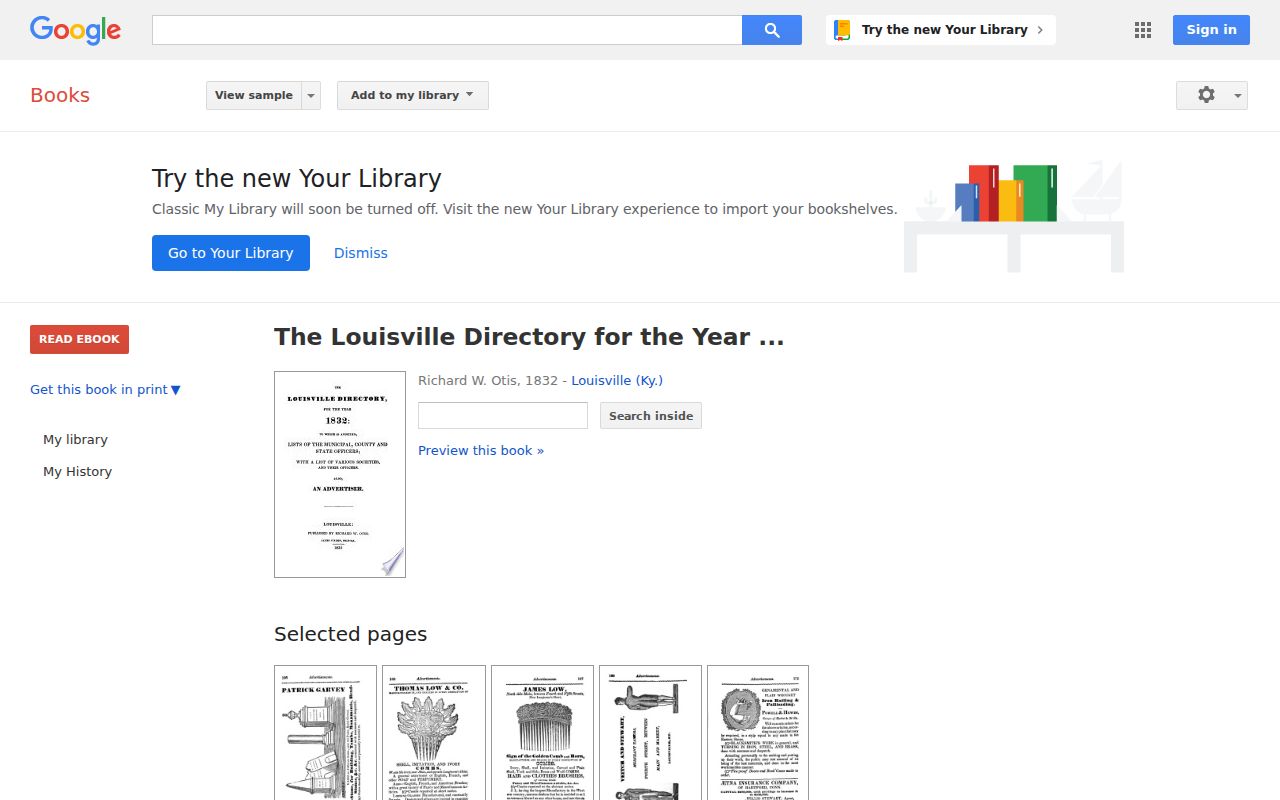
The captured record confirms the volume and makes name searching possible, but a final citation should come from the actual page image, not search-result text alone.
Publication was not continuous before the mid-1860s. That matters when a name disappears. Search spelling variants and the next available year before treating the gap as a move or death.
Read a Louisville Directory Entry
A Louisville city directory entry can contain surname, given name or initials, spouse or relationship notation, occupation, employer or business, street address, widow notation, and an owner, renter, or boarding mark when that publisher used one. It may also point to an advertisement. Never add a spouse, status, or address that the printed line does not state.
- Copy the name and spelling exactly as printed.
- Record every initial and relationship mark.
- Transcribe the full street and number.
- Save the occupation or business wording.
- Note the volume, year, page, and repository.
- Read the front-matter key before expanding an abbreviation.
- Criss-cross directory
- A volume arranged by street or address instead of only by surname.
- Householder index
- An address-oriented list of the named householder or listed occupant.
- Abbreviation key
- The publisher's own guide to short forms, marks, occupations, and household status.
- Directory snapshot
- A dated publication, not a continuous or complete resident roll.
Louisville City Directories at LFPL
The LFPL Kentucky History collection pairs directories with census, newspapers, cemetery records, vital indexes, wills, tax files, and clippings. Its city run begins in 1832; suburban directories begin in 1957. Ancestry Library Edition and the Kentucky History Research database are available through library locations under their access rules.
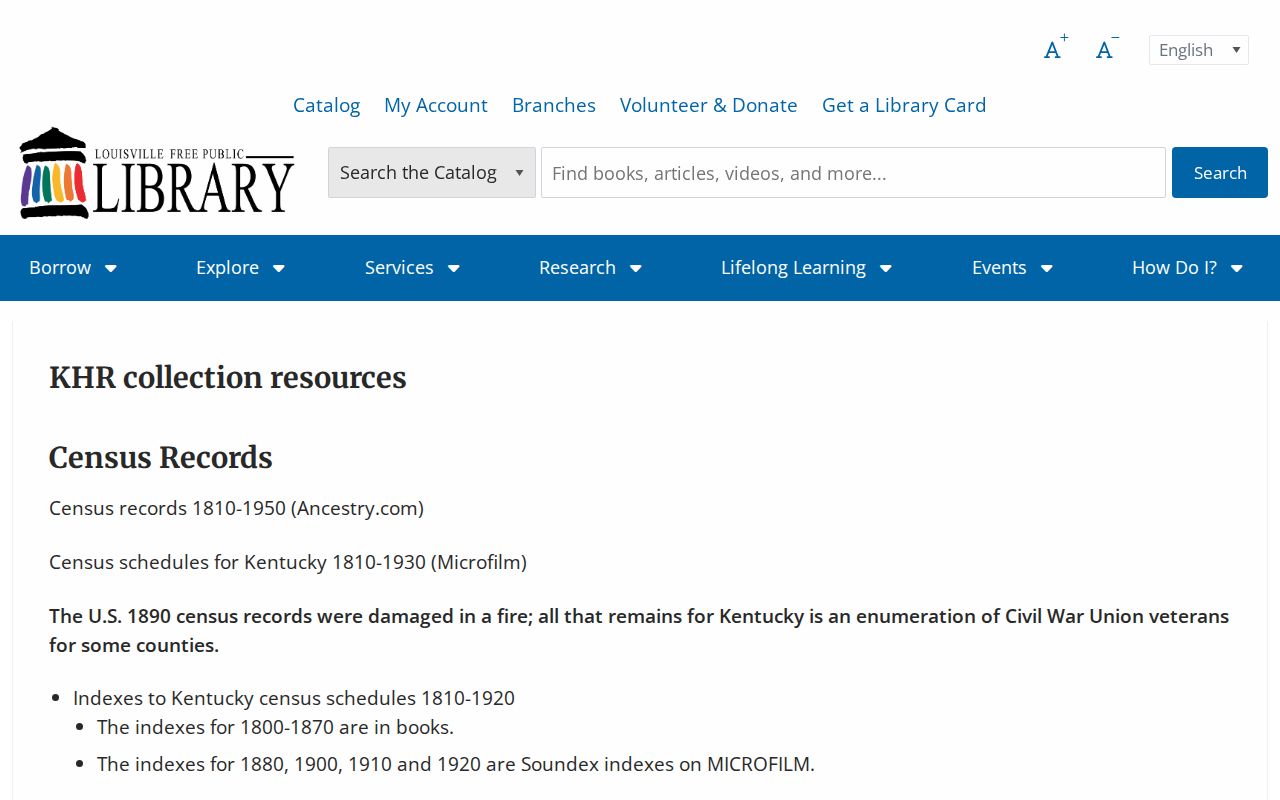
The collection screen shows why LFPL is more than a directory shelf: nearby sources can confirm the person, event, and date found in a volume.
The Main Library Kentucky History Room is closed during renovation. Remote Ask Librarian service remains available, and branches provide database access. A free LFPL card is available to people who live, work, attend school, or own property in Jefferson County. Listed cards for other Kentucky counties cost $35 per year, subject to current proof rules.
Louisville Directory Microfilm Routes
Metro Archives' microfilm inventory places city directories beside tax, land, vital, probate, naturalization, marriage, census, and pension indexes. That arrangement supports a strong fallback when no full digital scan exists.
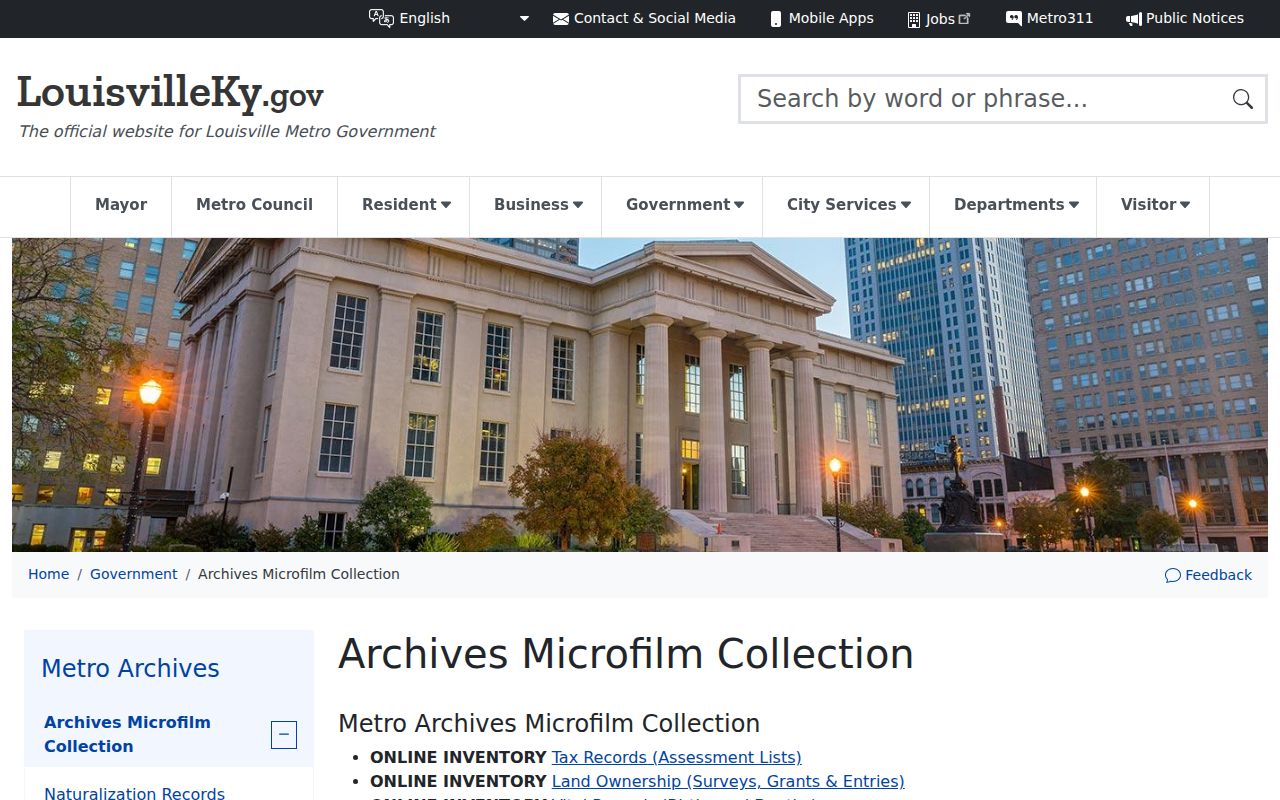
The inventory helps a researcher name the correct series before contacting Archives, which is far more effective than asking for every record about a person.
Metro's directory coverage is 1832 through 2000 with a Civil War-era gap. For a missing year, check LFPL, KHS, and Filson as well. Repository coverage overlaps, but it is not identical.
Filson Explains Louisville Directory Language
The Filson African American genealogy guide explains that early directory publication was uneven and identifies gaps in 1944, 1948, and 1950. It also warns that pre-1865 entries may use historic terms such as “free colored” or the abbreviations FWC and FMC. Preserve the source's words in a transcript, then explain their historical context. Do not silently turn an old index label into a modern identity claim.

The captured guide connects directory names with tax, court, church, cemetery, probate, birth, death, and census records held by the repository.
Filson also lists Louisville Death Register records from 1866 to 1910, births from 1898 to 1910, wills, estates, marriages, court books, and census material. Those sources can test a directory identity without making the directory carry more weight than it should.
Louisville City Directories Turn Street-First
Filson's house-history guide identifies 1884 as the first Louisville street-address index. Before that milestone, start with the occupant surname and use the printed address after finding the name. The 1884 Caron's volume marks the shift toward useful street reading. A researcher can then compare a block, adjoining entries, work, and household marks.
The same guide documents the 1909 renumbering of S Clay. Benjamin Gerwing appears at 1601 S Clay before the change and 801 S Clay after it. This example disproves a common myth: the same house does not always keep the same street number. Search both forms, nearby cross streets, and years on either side of the change.
Trace Louisville Families by Directory
City directories are strongest when used as repeated snapshots. A single entry is not proof of a full household or uninterrupted stay. Move one year at a time where volumes exist, and use independent sources at key dates.
- Begin with the exact address or surname and likely year. Copy the entry without expanding uncertain marks.
- Check the next available directory by both surname and address. Search old and new numbers around 1909.
- Compare the prior and following federal census. A census is a separate decennial snapshot governed by the federal release rule.
- Use the LFPL obituary index, vital indexes, cemetery material, probate, deeds, or permits to test the name and event.
- Keep original spellings and historic terms in notes. Explain them rather than modernizing the source.
The LFPL obituary index covers 1918 through 1987 and uses C, T, H, and P abbreviations, but it is not exhaustive. Courier-Journal coverage listed by KHR begins in 1868, while other local papers have separate runs. A directory result that needs a present-day check can move to the Louisville resident lookup without treating the old address as current.
Confirm Louisville Directory Names
A name in a Louisville city directory becomes more useful when another source confirms the date and role. LFPL's Kentucky History resources place directories beside census, newspapers, cemetery files, vital indexes, wills, tax material, and clippings. Its federal census holdings cover 1810 through 1930 through microfilm and library databases. A census can add household relationships, age, birthplace, and occupation as reported at one decennial date. It should not be treated as an annual continuation of the directory. Search the directory years immediately before and after the census, then note any shift in initials, work, spouse notation, or address.
Newspapers supply another dated check. KHR lists the Courier-Journal from 1868 to the present, the Louisville Times from 1884 through 1987, and the Louisville Defender from 1951 through 2022, along with older Catholic, Irish American, commercial, and daily papers. The LFPL obituary index covers 1918 through 1987 and uses C, T, H, and P abbreviations for newspaper titles. It is an index, not a complete run of every death notice. Record the surname, date, abbreviation, and page clue, then inspect the newspaper image when access allows. Cemetery resources for Cave Hill, Eastern, Greenwood, and Schardein can help separate people with similar names.
Vital and probate sources fill other gaps. KHR lists incomplete Kentucky vital material for 1852 through 1910, later birth and death indexes, Jefferson wills from 1784 through 1977, and marriage and divorce runs with their own dates. Filson identifies a Louisville Death Register from 1866 through 1910, a Birth Register from 1898 through 1910, wills, estates, marriages, and court books. Metro Archives microfilm includes naturalization indexes split A-L and M-Z, as well as land, marriage, tax, probate, census, and pension material. Each collection describes a particular event or legal role. Pair the exact name, date, address, and repository reference before deciding that two entries describe the same Louisville resident.
Louisville Directory Collection Timeline
The local sequence helps select the right search method. It also shows why digital-only research misses part of the shelf.
| 1832 | First known Louisville directory, published by Richard W. Otis. |
|---|---|
| Mid-1860s | Publication becomes more regular after uneven early runs. |
| 1884 | Filson identifies the first street-address index milestone. |
| 1909 | Address renumbering changes the S Clay example from 1601 to 801. |
| 1957 | LFPL suburban-directory coverage begins. |
| 2000 | Metro Archives' stated city and suburban run ends. |
| Present | LFPL describes Louisville city and suburban holdings as continuing. |
Publisher changes, missing years, and collection limits should be logged with each result. The KHS finding aid is the exact year locator for its holdings, not proof of every directory ever printed.