
Walk a Louisville Street Record
A useful Louisville street directory search moves through records that serve different jobs. The Jefferson County PVA Property Search supplies the assessed owner and parcel ID. LOJIC shows how that parcel sits beside other lots. The Jefferson County Clerk index connects an owner name to deeds and other recorded instruments. A lawful voter-file request may add registered voters, but it is not an open household list. City directories provide an older street reading.
Keep a dated note for each result. A tax owner may be a trust or company, and a mailing address may differ from the situs address where the parcel lies. A deed party may be a seller, buyer, lender, trustee, or representative.
- Search the PVA Address tab and save the returned address, parcel ID, assessed owner, value, acreage, neighborhood, and update date.
- Open LOJIC Online, find the address, turn on Addresses and Properties, and open the parcel report.
- Search the owner in the Clerk Party Name index. Read the instrument and party role before treating a hit as a sale.
- Use voter material only through the Kentucky self-lookup or a regulated SBE-84 route.
- For an older household, check Louisville directory address indexes, then compare census, deed, and obituary evidence.
Search Louisville Streets in PVA
The free PVA Basic Search accepts an exact address, a street-only string, or a range. Punctuation, city, state, and ZIP are not required. It also accepts a parcel ID without spaces or dashes. A partial parcel number may return a range. The result card can show situs address, owner, parcel ID, assessed value, acreage, neighborhood, and an update notice. Owner, Legal, and Sales Search tabs are subscription routes. Expanded data is also available at the PVA office or an LFPL branch.
| PVA control | Operation | Street use |
|---|---|---|
| Address | Exact address, street, or range | Browse parcels by address |
| Parcel ID | Full or partial number | Return to one legal parcel |
| Owner | Subscription tab | Search assessed owner |
| Legal | Subscription tab | Connect lot or subdivision text |
| Sales | Subscription tab | Inspect transfer criteria |
The PVA owner-search guidance is shown in the captured official page.
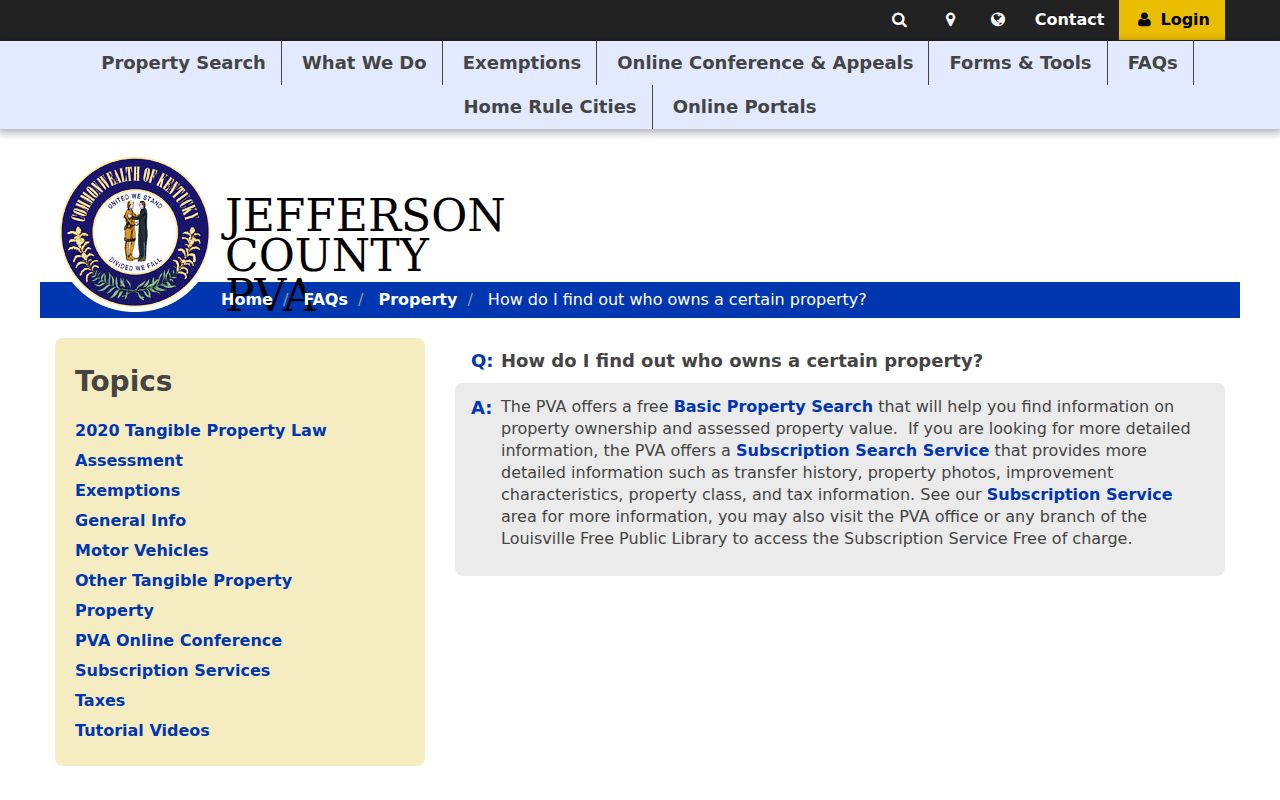
The image shows the key access split: basic address and parcel searching is free, while some name, legal, and sales functions require broader access.
Map Louisville Streets with LOJIC
LOJIC is a partnership of Louisville Metro, MSD, Louisville Water, and PVA. The public viewer accepts an address, street, or intersection. Gray, Basic, and Aerial basemaps pair with Streets, Addresses, Properties, and Labels. After a parcel click, the viewer offers Parcel Report, Land Development Report, and General Information Report choices. Buffer, Measure, Draw, Print, X/Y Coordinate, and Historic Imagery tools support close inspection.
Use the map for orientation, not legal proof. LOJIC warns that parcel lines are not legal boundaries. The deed, plat, legal description, and PVA record control that issue. Historic imagery services span selected years from 1997 through 2022, but an image shows structures, not occupants.
- Parcel
- A mapped and assessed unit of land.
- Situs address
- Where the parcel lies, which can differ from the tax mailing address.
- Plat
- A recorded map of lots, streets, or easements.
- Criss-cross directory
- A volume arranged by street or address.
Louisville Records Arranged by Address
No one row is a complete Louisville street directory. The PVA identifies an assessed owner. LOJIC places the parcel. Clerk instruments document legal acts. Metro portals record permit and code activity. Historical directories name listed occupants at a publication date.
| Record | Keeper | Contribution | Access |
|---|---|---|---|
| Assessment | Jefferson PVA | Situs, owner, parcel, value, acres | Free basic search |
| Parcel map | LOJIC | Street context, reports, imagery | Public viewer |
| Deeds | County Clerk | Parties, dates, control, legal description | Online August 1984 forward; archive 1966 to 1984 |
| Permits | Louisville Metro | Cases, status, dates, named roles | Portal; pre-June 19, 2019 gap |
| Directories | LFPL, Archives, KHS, Filson | Historical listed occupant and address | Library, archive, digital routes |
When a portal fails, call or visit its custodian, use a request channel, or ask a library for a known year. Include address, parcel ID, date span, and document type.
Read Louisville Streets Through Deeds
Online Land Records cover August 1984 forward. ArcaSearch covers 1966 through 1984. For earlier work, use the Deed Room, books, microfilm, Metro Archives, or KDLA. The exact pre-1966 boundary was not stated, so do not invent one.
Start with the PVA owner as grantee, or buyer, and filter for a deed near the likely purchase. Record grantor, grantee, dates, book/page or control number, and legal description. Then search the seller as an earlier grantee. A mortgage, lien, release, easement, power of attorney, or name change may name a person without transferring title. Lot, block, condo, and plat references matter when one street address covers many units.
The Clerk search also offers Control Number, Book/Page, Reference Number, Refers To, Instrument Type, and Marriage routes. Those paths are useful when a party name is common or an earlier note already supplies a book and page. The Party Name screen supports grantor, grantee, or both, Pure Alpha or Exact Match, a date range, instrument filters, and groups for wills, name changes, corporations, and liens. Save the search settings with the hit. A result list is only an index summary until the linked image is read.
The Deed Room at Metro Hall provides the human fallback. Staff can help locate older deeds, mortgages, liens and releases, wills, name changes, subdivision plats, and condominium plats. Ask with a parcel ID, legal description, book/page, party name, and narrow date span whenever possible. Free screen viewing and printing are described online, while copies, certification, research help, and office services may carry fees. Confirm the current charge before ordering.
Louisville Street Numbers Have Rules
Louisville uses Main Street as a north-south divider in the core, Shelbyville Road as the east-west baseline to the east, and First Street as an east-west divider. East-west streets begin near First, while north-south streets begin near Main or Shelbyville. The general rule places odd numbers on north and east sides, even numbers on south and west sides.
Hundreds blocks advance with numbered cross streets in the core. Merged-city edges and old roads can differ. Keep the old spelling, direction, suffix, and number in the search log. This helps a by-address search survive a street change.
The 1909 Louisville Address Shift
The Filson house-history guide supplies a clear local trap. Benjamin Gerwing, a draftsman for American Machine Co., boarded at 1601 S Clay before the 1909 renumbering and at 801 S Clay afterward. An address-only search could make him seem to vanish.
Search years on both sides of a shift. Compare the street index, name, nearby cross streets, work, and deed description. Preserve both numbers. An address is not a permanent ID. Parcel splits, condo conversion, postal changes, renamed streets, and annexation can break the surface address while the parcel trail continues.
Louisville Directories Turn Street-First
The Filson guide identifies 1884 as Louisville's first street-address index milestone. Earlier work begins with a surname. Later volumes can be read by block. LFPL reports city directories from 1832 to the present and suburban directories from 1957 to the present. Metro Archives reports 1832 through 2000 with a Civil War-era gap.
Record each name exactly, plus initials, household notation, occupation, owner or boarding mark when present, year, and abbreviation key. The full shelf belongs on the Louisville city directories page; here it serves street reading.
Louisville Address Permits Add Dates
The Metro Codes portal can add permits, maintenance cases, complaints, licenses, status, and dates. An applicant, contractor, owner, or complainant is a file role, not proof of residence. Check it against the parcel and deed.
The Accela system does not include Metro311 requests before June 19, 2019. A blank older result proves nothing. Ask Metro for a specific address and period, or submit a focused Kentucky Open Records request.
Louisville Street Voter Data Limits
Kentucky's Voter Information Center is a self-lookup. It asks for legal first and last names, birth date, and optional last four SSN digits. It has no street browse. An SBE-84 file may be scoped by county, precinct, or district and delivered in street order, but the requester must qualify under KRS 116.095 and 31 KAR 3:010.
Lists may include name, address, age code, party, gender, ZIP, and five-year participation history. They exclude ballot choices and protected fields. A street list is not a census. Children, unregistered adults, and protected voters may be absent.
Louisville Street Directory Fallbacks
A blank portal result should change the access route, not end the search. For current parcel facts, use the free PVA address or parcel search first. Owner, legal, and sales tabs require subscription access, but the research identifies free expanded access at the PVA office and LFPL branches. Preserve the parcel ID before switching channels. It is more stable than a typed street label and helps staff distinguish similar addresses. When LOJIC does not load, its help material still identifies the report path, and the PVA record remains the source for assessed ownership. For a boundary or title issue, request the recorded plat or deed rather than treating a map line as final.
The Jefferson County Clerk provides several routes for land records. Its current index covers August 1984 forward, while ArcaSearch covers 1966 through 1984. The Deed Room at Metro Hall handles older books, deeds, mortgages, liens and releases, wills, name changes, subdivision plats, and condominium plats. Call 502-574-6220 with a narrow question. A strong request includes the parcel ID, exact street forms, party names, likely dates, and any known book, page, control, or reference number. The precise pre-1966 digital or microfilm cutoff was not stated on the inspected pages, so staff help, Metro Archives, or KDLA is safer than assigning an unsupported year.
Permit and code research has its own gap. Louisville Metro's current Accela system does not contain old Metro311 requests from before June 19, 2019. Ask the relevant Metro custodian for the address and date span, or use the Metro open-records request route. Kentucky's core request rule calls for a signed, adequately described request and a response within five business days, though a custodian may identify another office or explain a lawful delay. For an old city directory entry, use LFPL Ask Librarian while the Main Library Kentucky History Room is closed, or contact Metro Archives, KHS, or Filson for the exact volume. These fallbacks keep a street directory search tied to real holdings instead of guesses.
Limits of Louisville Street Records
Ownership, occupancy, registration, and publication are distinct. The PVA lists an owner, not each person. Deeds show transaction roles. Voter data covers registered voters under access rules. A directory is dated. DMV, utility customer, delivery, private association, and protected-address lists are not ordinary public street records.
Use the Louisville street directory chain for family history, house research, civic study, or a careful personal transaction. Verify with the custodian. Never infer a whole household from a partial roll or defeat Safe at Home protection.
Lawful use. Louisville address records must not be used to stalk, harass, intimidate, or expose a protected person.